
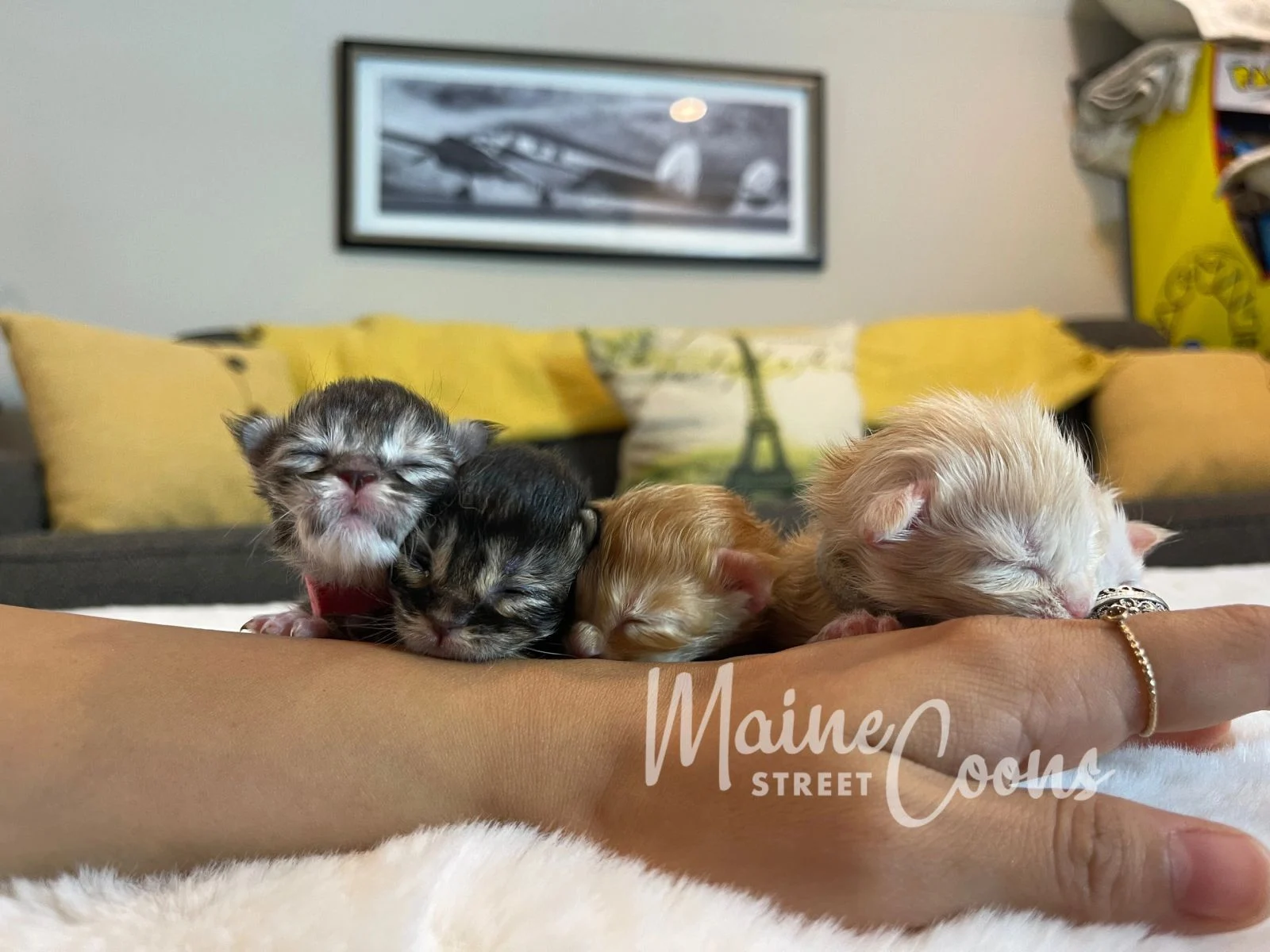
Birth to 14 Weeks
Maine Coon Kitten Development by Week
Maine Coons grow up slowly, and they do not reach their full adult size or coat until 3-4 years of age. That is why the 14 weeks each kitten spends with us matter so much: it is the time they need to become strong, healthy, and self-assured before they move in with a new family. Follow your kitten’s journey with us, from the day they are born to the day they go home!
Week-by-Week Maine Coon Kitten Growth
The First 48 Hours
A newborn Maine Coon kitten is extremely fragile. From birth to nine weeks, even an exceptionally well-managed cattery can expect losses of 18% to 30% of its kittens. The majority of those losses happen in week one, and nearly all of them happen within four weeks. Once a kitten passes the four-week mark, its odds of survival rise dramatically. At Maine Street Coons, we do all we can to beat those numbers! Even so, we hold off on birth announcements and kitten commitments until the kittens are ten weeks old.
Mama Cat: Opens the sac, severs the cord, and cleans her newborn
This work belongs to her, and most of the time she handles it by instinct. We avoid stepping into this natural bonding moment unless Mama Cat needs help. A first-time mother can feel overwhelmed, and a birth can sometimes turn complicated, so we always stay close and ready to assist.
Kitten Nutrition: Colostrum delivers vital antibodies and nutrients
For Maine Coon kittens, nursing on Mama Cat's colostrum within an hour or two of birth is key to building immunity and protection from disease. We watch closely to make sure each kitten gets it as soon as possible, because kittens who receive colostrum are far more likely to survive to six weeks. Colostrum, the "first milk" a mother cat makes, is rich in protein, essential nutrients, and the all-important protective antibodies that give newborns a real fighting chance.
Kitten Behavior: Staying warm is a vital early skill.
A newborn Maine Coon kitten cannot thermoregulate, meaning it cannot hold its own body temperature steady. Warmth is essential to prevent hypothermia, sickness, and death, so we watch it carefully during the first several weeks.
Physical Appearance: Few people would recognize a Maine Coon yet.
Just like every other newborn kitten, a Maine Coon is born blind and deaf. It follows its nose, wriggling toward Mama Cat (with a little help from us if needed). Newborns are sweet, but they bear little resemblance to their parents at this point.
Physical Changes: Birth weight typically doubles by week's end.
After each kitten is clean, dry, and has nursed on colostrum, we weigh it and log its birth weight in grams. We track Maine Coon kitten growth by weighing every kitten each day for the first three weeks, and we expect a gain of at least 10g daily. If a kitten falls short, we step in to make sure it is fed and hydrated. Our hope is that every kitten holds or gains weight each day and doubles its birth weight before the first week ends.
Week 1 (Days 3-7)
In this stretch, we aim to disturb the Maine Coon kittens as little as we can. We record each kitten's weight at the same time every day and, whenever needed, change the linens or add supplemental feedings.
Physical Changes: Small but meaningful progress
For days 1-5, the umbilical cord stays attached as it dries. At about 4-5 days, it drops off naturally. Soon after, Kitten's ear canals start to open, and it gradually begins hearing a few clear sounds, such as Mama Cat's purr and our soft, loving whispers.
Kitten Nutrition: The race for milk begins!
It may surprise you, but the contest for rank and territory starts this early for a Maine Coon kitten. Using smell and touch, Kitten pulls itself across the nest to locate Mama Cat's dinner plate, then has to wriggle and push to win a spot. Once there, Kitten tries to stay latched and nurses as often as it can, at least every 2 hours. If the dinner plates are outnumbered by kittens, or Mama Cat's milk comes in slowly, keeping every kitten full consumes our days and nights.
Kitten Behavior: Lots of sleep, with Mama Cat always near
During these crucial first days, the tiny newborn (still blind, deaf, and helpless) sleeps 90% of the time and eats for the remaining 10%, building a strong bond with Mama Cat, its source of food and steady warmth. Mama will leave to use the box when she needs to, and her own appetite slowly picks up through the week, but she spends most of her time devoted to her kittens. Caring for them is a full-time job, and it takes an enormous amount of her energy.
Mama Cat: Handles every messy job
Since newborns cannot "go" by themselves yet, Mama Cat grooms their bellies with her tongue to help them eliminate. Bless her heart, she also takes care of the cleanup afterward, which we call "Booty Duty."
Human Socialization: Kept to a minimum
This week, we are simply there to help Mama Cat if she needs it. Supporting her lets her do her best for her babies. Kitten senses that we are nearby, but imprinting does not happen yet.
Week 2 (Days 8-14)
Week two brings plenty of "more of the same" along with a few important changes. Mostly, it is a week of sleeping and eating, plus key physical developments that start the gradual move toward independence.
Mama Cat: Still runs the show
At two weeks old, a Maine Coon kitten is still unable to retract its claws or regulate its body temp. It stays with its littermates in the 80-degree nest beside Mama Cat, who meets her babies' every need.
Kitten Nutrition: A heavy load for Mama
In a big litter, the scramble for milk becomes intense! Nursing these babies every 2-3 hours takes a huge toll on Mama Cat's hydration and energy. She may need to step out of the nest more often to eat or drink, though never far and never for long. A single whimper, and she hurries right back!
Toileting: Still the same.
At two weeks, kittens still need help to go to the bathroom, and Mama Cat is still the one handling the messy cleanup.
Physical Changes: Eyes start to open
Somewhere between days 7-10, Kitten starts opening its eyes, sometimes one before the other. Its vision starts out fuzzy, and Kitten is EXTREMELY light sensitive. It is true that every Maine Coon kitten has blue eyes at this age, but those eyes will not stay blue. Apart from white cats, blue-eyed Maine Coons fall outside the CFA, TICA, and LCWW Maine Coon breed standard. Our cats all grow up to have gold, copper, or green eyes.
Ears like a little bear cub's
Sometime this week, Kitten's ear canals finish opening and its hearing gets sharper. The change you will notice is in the ears themselves: they look small and round and sit on the sides of the head, just like a sweet baby bear cub. It is such a charming stage of Maine Coon kitten development that we love snapping photos! Not to worry, those ears will move up into their proper spot before long!
Kitten Behavior: Finds its voice
As this week wraps up, Kitten knows how to cry out when it is upset, and it may even attempt a hiss at strange scents and noises, which never fails to make us laugh. 🤭
Human Socialization: Kitten's big debut
By this point, Kitten knows me well: my scent, the sound of my voice, and how warm my hand feels. I have been weighing every day, supplementing feedings when needed, swapping out box linens, taking group photos, organizing dinner plates, and whispering sweet nothings, around the clock. Now comes the joy of introducing Kitten and its littermates to the world with a birth announcement!
Week 3 (Days 15-21)
Week three is Kitten's last week as a neonate before it moves with Mama Cat into the Toddler Nursery. It is a week full of changes, including accepting me as Mama's helper.
Mama Cat: A First Taste of Freedom
Maine Coon kittens still rely on Mama Cat and their littermates to stay warm, but Mama can now step away for a little longer. Every so often, she even lets me babysit!
Kitten Nutrition: Bigger Meals, Fewer Feedings
Kitten still relies entirely on nursing, but now nurses less often (5-6 times per day) and takes in much more milk at each meal.
Kitten Behavior: A week of firsts
Over these days, Kitten starts finding its balance, learns to stand, takes those first shaky steps, begins to purr, and even starts grooming itself! So many firsts are on the way this week!
Toileting: Kitten takes charge
Once Kitten starts walking near the end of the week, things move fast: from needing help to go, to going alone, to finding and using the litterbox, just as Mama Cat does.
Physical Changes: Ears in their proper place
Now Kitten's ears stand tall on top of its head, a bit like a tiny Maine Coon cat. At this stage, Kitten is simply irresistible.
Week 4 (Days 22-28)
This week brings major changes, starting a gradual handoff of duties from Mama Cat to Kitten and to us humans. Mama Cat will still have plenty to do over the next two months, but she starts easing back on her care to encourage Kitten's independence and to keep the humans in line.
Mama Cat: Moving house with kittens in tow
At four weeks old, the kittens and Mama Cat leave our maternity ward and settle into our kitten nursery. It is a cozy room with lots of kitten-sized litter boxes, mess-proof floors, and plenty of things to spark curiosity and help them grow in confidence.
Physical Changes: A tiny Maine Coon takes shape
By now, every kitten has its deciduous (baby) teeth and truly starts to resemble a very fluffy, miniature Maine Coon. Absolutely adorable! This is when our pre-approved adopters start to get a sense of how each kitten will look as an adult, and some may find themselves drawn to photos of particular kittens.
Kitten Nutrition: Solid food slowly enters the picture
Early this week, we introduce Kitten to warm formula in a dish, then to gruel, a sloppy blend of warm wet kitten food and formula. Kitten still nurses four times a day, but it is learning to fill its growing appetite with gruel
Toileting: Litter training is a big deal
At this point, kittens are able to urinate and defecate by themselves. Next, they have to learn to notice the "Uh-oh, I gotta go!" feeling and get to the box, and into it, in time. It is true that most kittens know by instinct how to use the box once they are in it. Still, using it every time (not only when it is convenient) and covering their waste correctly takes some practice and repetition. This week, our aim is to move from occasional use to proper use, every single time!
Human Socialization: Now they actually like us
Before this, Kitten most likely put up with us or accepted us, but mostly ignored us. Now Kitten starts to see us as a source of food, play, and snuggles, and the more outgoing a kitten is by nature, the more it will come looking for our attention. That shift is one of the milestones we assess for the temperament evaluation that goes home with every kitten.
Week 5 (Days 29-35)
Mama Cat: Tough love starts
For the first time, Mama starts practicing tough love this week, refusing Kitten's attempts to nurse more and more often and nudging the kittens toward independence. She will also start correcting behaviors she does not like.
Kitten Nutrition: Weaning gets serious
At five weeks, Kitten eats wet kitten food 4x daily, always has water and Royal Canin dry mother & baby kitten food available, and still nurses, though only 1-2x a day.
Physical Changes: A budding athlete
Kitten's eyesight is now crystal clear. Kittens can right themselves, jump, run, place each paw with precision, steer around obstacles, stalk, pounce, and lock onto “prey” with their eyes. Their hunting instincts are taking shape.
Week 6 (Days 36-42)
Kitten Nutrition: Mastering new mealtime habits
At six weeks, all of a Maine Coon kitten's deciduous (baby) teeth have come in, and Kitten is skilled at eating wet food and starting to like dry kibble. This phase of weaning is stressful for Kitten, and it is when he or she truly begins to imprint on us. Naturally, we keep a careful eye on who eats what and offer extra gruel when needed so that Kitten keeps a healthy weight, stays hydrated, and remains in good overall condition.
The Litter Box: Nearly there, not quite
Litter box habits are sticking, with only a rare accident here and there.
Kitten Behavior: The little daredevil
It is a delight to watch Kitten groom himself or herself constantly, use the scratching posts, play with toys, and scale obstacles. It is less of a delight trying to predict every leap Kitten might take and keep everyone safe. A kitten that is eager to try something risky, and does it before its littermates, is showing another trait we watch for when picking out our boldest and most outgoing kittens.
Week 7 (Days 43-49)
Kitten Nutrition: Dining like a grown cat
Kitten now eats wet food on a schedule (twice per day) and always has dry kibble and water available.
Physical Changes: Vaccines start building immunity
At seven weeks old, our kittens make their very first trip to the veterinary clinic. During this visit, Dr. Wright or Dr. Mann checks their heart and lungs, looks over their boning and bellies, and examines their ears, eyes, and nose. Each kitten with a clean bill of health then gets the first of three sets of core vaccines. The vaccines are given again at Week 10 and Week 13, and the last set also includes rabies.
Human Socialization: Best friends now
Things start to get really fun at this point. Kitten notices the moment we walk into the nursery, toddling or dashing over and competing hard with its brothers and sisters for our time and affection. We are no longer just welcome guests; we are friends! It is a thrilling step along the path of Maine Coon kitten growth!
Week 8 (Days 50-56)
Physical Changes: Grams become pounds
Kitten has grown a great deal since birth, so we now weigh once a week, using pounds rather than grams. At this age, a typical female kitten weighs about 2.5 to 2.75 pounds, and males usually weigh 2.75 to 3.25 pounds. Keep in mind, these numbers are averages, so a kitten that weighs a bit more or less right now is neither unusual nor a worry. Kitten is getting everything it needs to grow into its full adult potential.
Human Socialization: Personality Assessments
Once Kitten turns ten weeks old, it can be reserved by a loving family on our Approved Adopter’s list. To get ready, we use the following two weeks to complete an individual personality assessment for each Maine Coon kitten, so we can make the best possible match!
Weeks 9-11
Kitten Behavior: Exploring the "big house" and learning the rules
By now, Kitten eats well and uses the litter box dependably, so it can start exploring the "big house" where we live with our alters and female Maine Coons. Here, Kitten gets its first taste of daily life as a cherished household pet and learns which behaviors are welcome and which are not. We do the teaching, but our clowder helps a lot, and they hold the kindle of kittens to a higher standard than we do!
Physical Changes: The second set of vaccines
At ten weeks, Kitten and its littermates go back to the vet’s office for round two of the three-part core vaccine series they get before going home. By this visit, everyone is full of curiosity, thrilled to meet the techs and doctor, and happy to pose for adorable photos for their new families.
Human Socialization: Company Is Coming!
With two rounds of vaccines behind them, kittens at this age can start welcoming visitors at the cattery. At times, it is a committed adopter hoping to meet their kitten before the big thrill of Gotcha Day! Other times, it is neighbors, friends, or family members, who offer valuable exposure to unfamiliar scents, sounds, and sights. That variety helps kittens grow confident around many kinds of people and situations.
Weeks 12-14
Kitten Nutrition: All nursing ends, "comfort" nursing included.
Your Maine Coon kitten now eats a balanced diet of premium Royal Canin Mom & Baby Cat kibble, wet kitten food, and FortiFlora. Because those teeth hurt, Mama Cat has stopped, or soon will stop, all nursing, and Kitten will settle comfortably into the new normal.
Kitten Behavior: Life is all about play.
By now, Kitten is fully at ease living alongside people and pets in the Big House. It spends every waking moment exploring its surroundings, sharpening its hunting skills, and making a toy or game out of anything it finds. Every new adventure adds to Kitten's confidence, and it is turning into a self-assured cat that should settle into your home with relative ease.
Physical Changes: Building strong immunity and size
At 12 weeks, Kitten gets the third and last round of core vaccines, plus the Purevax one-year rabies vaccine and a go-home health exam. Growth is rapid now: average weight climbs from 3.5 pounds to 5 pounds in males, and girls run about 1/4 to 1/2 pound lighter.
Human Socialization: Welcome to Your Family
In week 14, Kitten meets its new adoptive parent(s) and takes a giant step, leaving the familiar smells, sights, and sounds of Maine Street for a brand-new home. It is a big upheaval for Kitten, thrilling yet stressful. Stress WILL briefly lower appetite and immunity, so following our integration instructions closely is essential to keeping Kitten healthy over the next few weeks.